Walking & Running
Nordic Walking for Beginners
Born as summer training for Finnish cross-country skiers, pole walking adds arms, shoulders and back to an ordinary walk. Here is how to start.
General information, not medical advice. If you have a health condition, are pregnant or notice chest pain, dizziness or unusual breathlessness, speak to a GP or health professional before you start or carry on.
In this guide
Nordic walking is brisk walking with specially designed poles that you push against behind you, so your arms, shoulders and back work alongside your legs. It began in Finland as summer training for cross-country skiers and is easy for most beginners to learn.
From a distance, Nordic walking looks much like ordinary walking. On closer inspection there is a difference: the poles are used in a set technique, not simply carried or planted ahead for balance, and that turns a walk into a whole-body workout. Special poles for the activity were developed in Finland in the late 1990s, and the sport has since spread across Europe and the UK.
Poles: How They Differ and How to Size Them
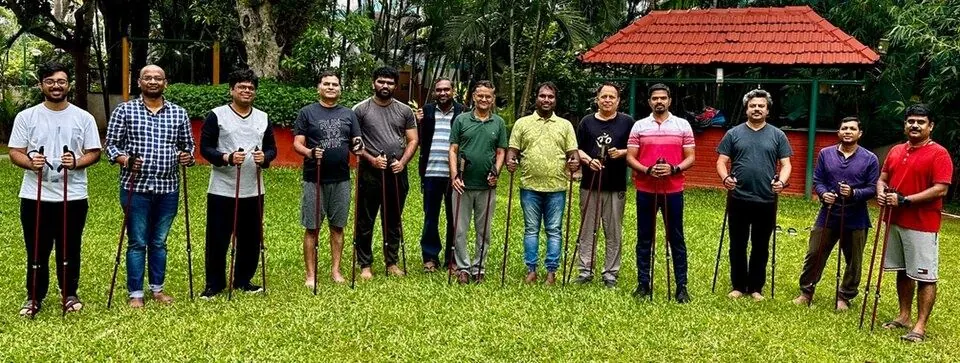
Nordic walking poles are not the same as trekking poles. Trekking poles have loose wrist loops and are planted in front of you for support on rough ground. Nordic walking poles have a glove-like strap that holds your hand, so you can push through the palm and let go of the grip at the back of each swing without dropping the pole. Rubber paws cover the tips for pavements; the spike underneath suits grass and trails.
A widely used rule of thumb is to multiply your height in centimetres by 0.68 to find a starting pole length. With the pole upright beside you and the tip on the ground, your elbow should bend at roughly a right angle. Adjustable poles let you fine-tune the length as your technique develops.
Basic Technique
- Walk with your normal stride, then let your arms swing in the opposite pattern to your legs: right arm forward with the left foot, and vice versa.
- Keep the poles angled backwards, with the tips landing beside you roughly level with the middle of your stride, never out in front.
- Push down and back through the strap as the pole passes your hip, then relax your hand and let the arm swing forward again.
- Stand tall, with relaxed shoulders, and lengthen your stride a little as the push develops.
Because the upper body joins in, Nordic walking uses far more muscles than ordinary walking. Harvard Health reports that studies estimate it burns between 18% and 67% more calories than walking without poles, and the poles give extra points of contact with the ground, which many people find steadier. Exactly how much benefit you get depends on your fitness, your technique and how hard you push.
Who It Suits and How to Get Started
Nordic walking suits beginners, people returning to exercise and older walkers who want a gentle but full-body activity. It may not suit anyone recovering from a shoulder, elbow or wrist injury. If you have a health condition, heart or joint problems, are pregnant, or get pain, chest pain, dizziness or unusual breathlessness, stop and speak to a GP or health professional before carrying on.
The quickest way to learn is a short course with a qualified instructor, who will check your pole length and correct your technique in the first few sessions. British Nordic Walking is the UK representative of the International Nordic Walking Association (INWA) and lists instructors and walks around the country; local health walk schemes and leisure services also run groups. Costs for poles, courses and sessions vary, so check with the provider before you book.